Endpoint settings
The Settings tab of an endpoint controls how it is listed, how results are paged and shaped, caching, streaming, limits, parameter rules and alerts. Changes take effect when you publish.
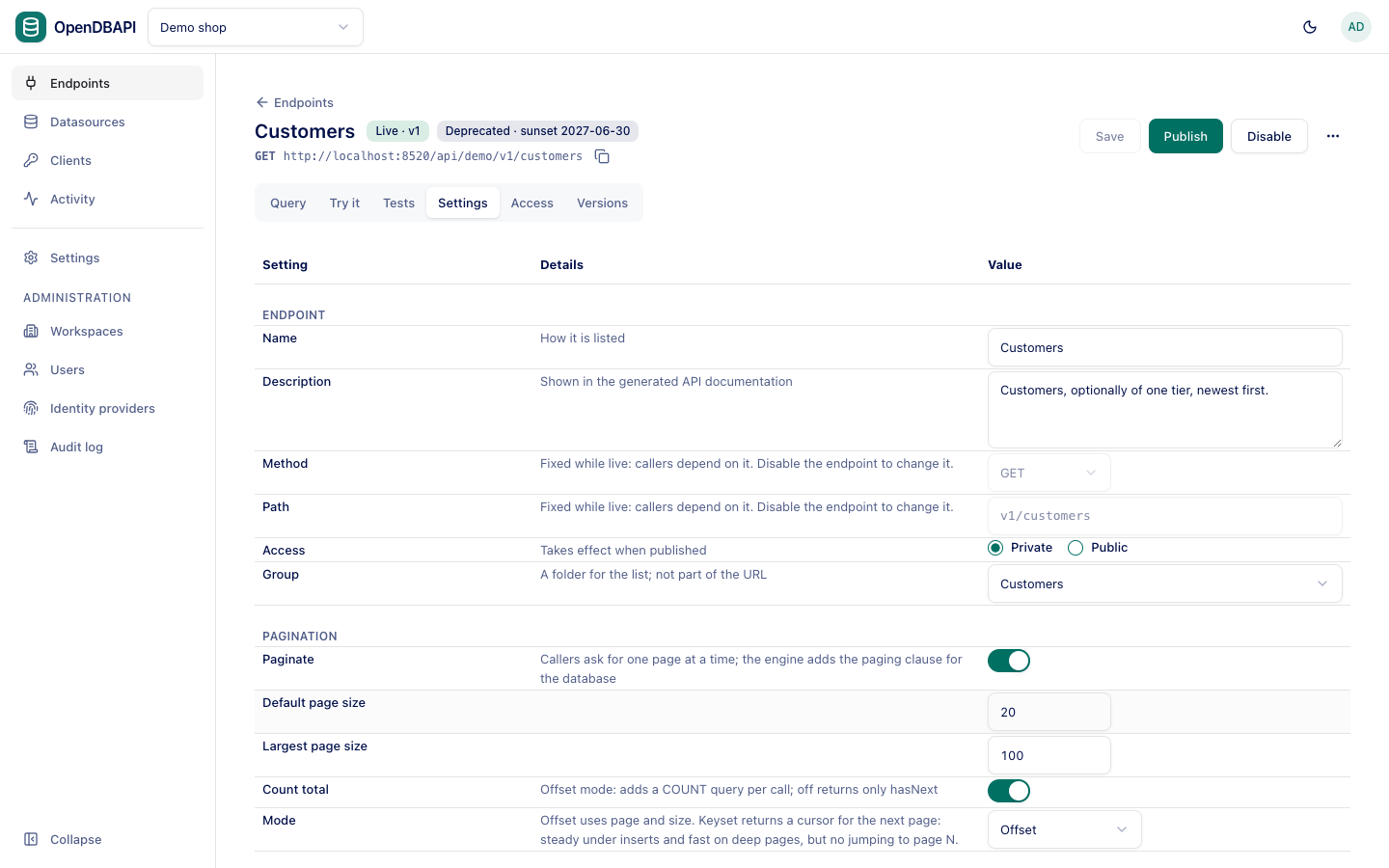
Endpoint
| Setting | What it does |
|---|---|
| Name | How it is listed |
| Description | Shown in the generated API documentation |
| Method | Fixed while live: callers depend on it. Disable the endpoint to change it |
| Path | Fixed while live, for the same reason. {name} segments become path parameters |
| Access | Private needs a client token; Public answers anyone |
| Group | A folder for the list; not part of the URL |
Pagination
| Setting | What it does | Default |
|---|---|---|
| Paginate | Callers ask for one page at a time; OpenDBAPI adds the paging clause for the database | Off |
| Default page size | Rows per page when the caller does not pass size | 20 |
| Largest page size | The biggest size a caller may ask for | 500 |
| Count total | Offset mode: adds a COUNT query per call and returns meta.total; off returns only meta.hasNext | On |
| Mode | Offset uses page and size. Keyset returns a cursor for the next page: steady under inserts and fast on deep pages, but no jumping to page N | Offset |
| Key columns | Keyset mode: the result columns the pages are ordered by; never null and together unique, so end with an id. Mark a key Newest / largest first to page downwards | — |
With pagination on, page, size, after and format are reserved parameter names.
GET /api/demo/v1/customers?page=2&size=20       offset mode
GET /api/demo/v1/events?size=50&after=eyJr…     keyset mode: after = meta.nextCursor of the previous page
Output
| Setting | What it does |
|---|---|
| Shape | List (an array of rows), Single object (the first row; no row answers 404 not_found), or Scalar value (the first column of the first row) |
| Key names | As in SQL, or camelCase, which turns created_at into createdAt |
| Value types | Convert a column's values: Decimal as text (money as text, so JavaScript keeps every digit), ISO 8601 date, Epoch milliseconds, Boolean (0/1) |
| Nesting | Group flat join rows into objects with collections: choose the id column, then a collection per prefix (e.g. order_ columns into orders) |
Cache
| Setting | What it does | Default |
|---|---|---|
| Cache answers | Keep successful GET answers in memory and serve them again until they expire; meta.cached tells callers | Off |
| Keep for | Seconds, up to 86 400 (one day) | 60 |
| Shared between callers | One entry for all callers instead of one per service account. Not allowed when data policies make answers differ per caller | Off |
Clear cache drops this endpoint's cached answers. Try-it calls are never cached. Cached answers are kept per server
instance, up to 128 MB (opendbapi.cache.max-bytes).
Streaming
| Setting | What it does |
|---|---|
| Allow streaming | Callers may ask for ?format=ndjson or ?format=csv (or the Accept header) to receive rows as they are read, without pagination |
| Formats | NDJSON, CSV, or both |
| Most rows streamed | Empty is the same as Most rows returned; up to 10 000 000 |
Limits
| Setting | What it does | Default |
|---|---|---|
| Timeout | Seconds; the query is cancelled after this and the caller gets 504 query_timeout | 30 |
| Most rows returned | More rows are cut off and meta.truncated is set | 10 000 |
| Rate limit | Calls per minute this endpoint answers across all callers; more answer 429 rate_limited with Retry-After | None |
| Transaction | Run all statements in one transaction; any failure rolls them all back | Off |
Workspace-wide limits per client and per IP address are in Security.
Parameter rules
Checks across parameters that run before the query, written in the same expression language as <if test>, each with a
Message for callers. A rule that does not hold (or cannot be evaluated) answers 400 rule_failed with the message. At
most 20 rules.
from == null or to == null or from <= to       "from must be before to"
ids == null or ids.size() <= 100               "Pass at most 100 ids"
Alerts
Alert on failures sends server errors (5xx) to the workspace's alert channels, at most once per error every few minutes.
Further reading
- Write and publish endpoints
- Calling endpoints: the response envelope, pages and streaming from the caller's side.