Data policies
Data policies change what a caller sees without changing the query: masks hide part of a value, row filters keep only the rows a caller may see.
Masks
A mask replaces a column's values in every answer:
| Mask | Result |
|---|---|
ada@example.com → a***@example.com | |
| Phone | 0901234123 → 090****123 |
| Keep the ends | Keeps Keep at start characters and Keep at end characters and masks the rest |
| Hash | Salted SHA-256: the same input always gives the same output, so callers can still join and group |
| Always null | null |
Set a mask in one of two places:
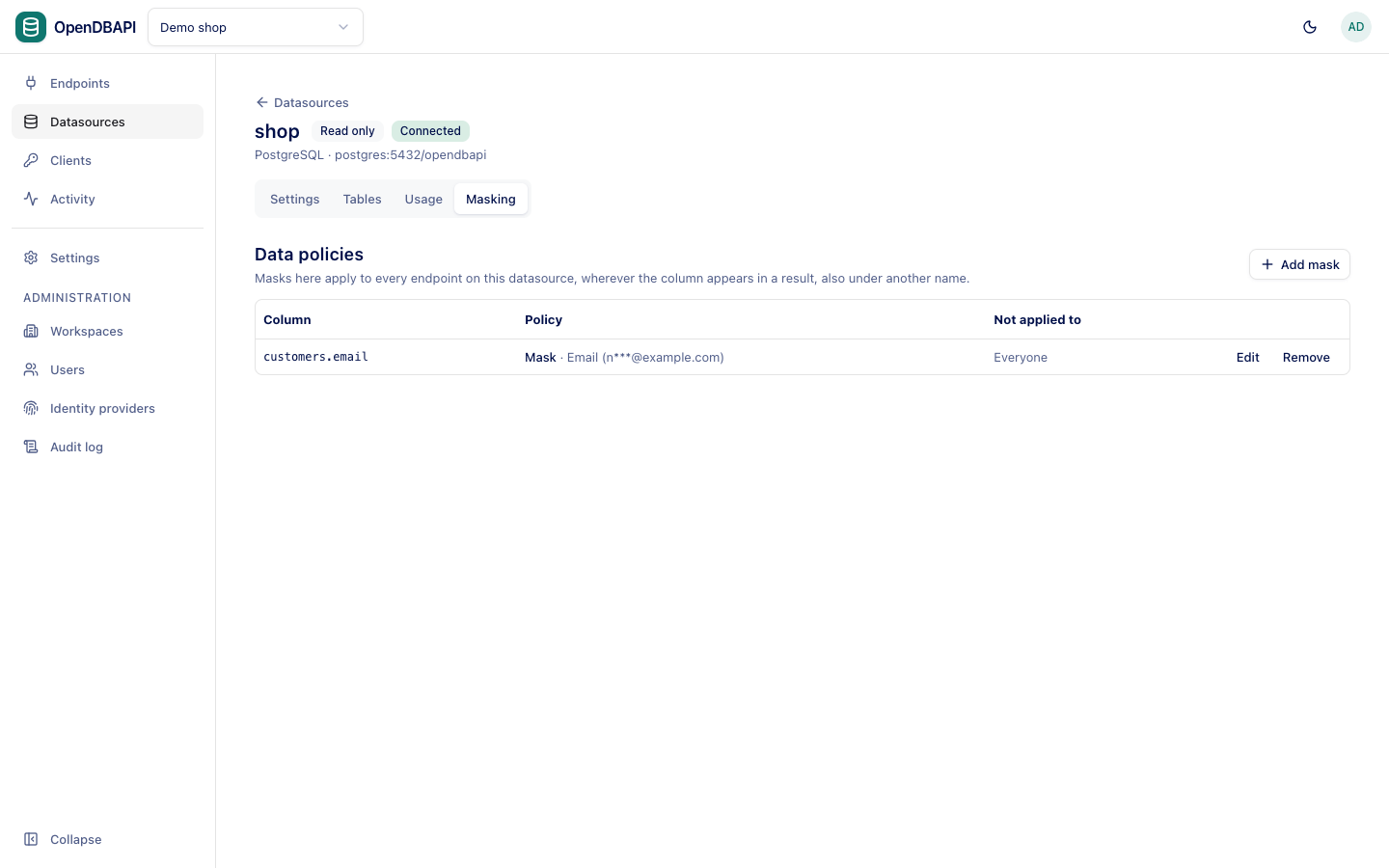
- On a datasource (Datasources → the datasource → Masking → Add mask): name a Table column such as
customers.emailorshop.customers.email. Every endpoint on the datasource masks it, wherever it appears in a result and under any alias, because OpenDBAPI traces each result column back to its table column. - On an endpoint (the endpoint's Access tab): name a Result column as the endpoint returns it.
Not applied to lists service accounts the mask skips, for example a support tool that needs real emails.
When the SQL cannot be parsed to trace columns (vendor-specific syntax), datasource masks apply by result column name only, and validation warns about it. Alias masked columns with their own name in such queries.
Row filters
A row filter, set on an endpoint's Access tab, keeps only rows whose column equals an
attribute of the calling service account. For example, a row filter on country with the
attribute country gives the reporting account, whose attribute is country = VN, only Vietnamese customers. A list
attribute (regions = north,south) allows several values.
- A caller without the attribute is refused with
403 missing_attribute. - A row filter needs to know the caller, so the endpoint must be Private.
- The column must be one the query returns, and the filtered query must be accepted by the database; validation checks both.
OpenDBAPI applies the filter by wrapping the endpoint's query, before pagination, so pages and counts only see allowed rows.
Where policies apply
Data policies apply to every way an endpoint answers: normal calls, pages, streams, cached answers (which are kept per caller when policies differ by caller), every query of a full-mode script or workflow, and tests that run as a service account. Preview runs without a caller, so it shows masks configured for everyone but not row filters.
Changing a policy clears the workspace's cached answers on every server instance.