Masks and row filters
A rule changes what a person sees in a table without denying access to it. A mask replaces the values of a column (hash, redact, show the last four characters). A row filter hides the rows that do not match an expression. Rules apply to everyone except the principals you exempt, and they are enforced in the query engine.
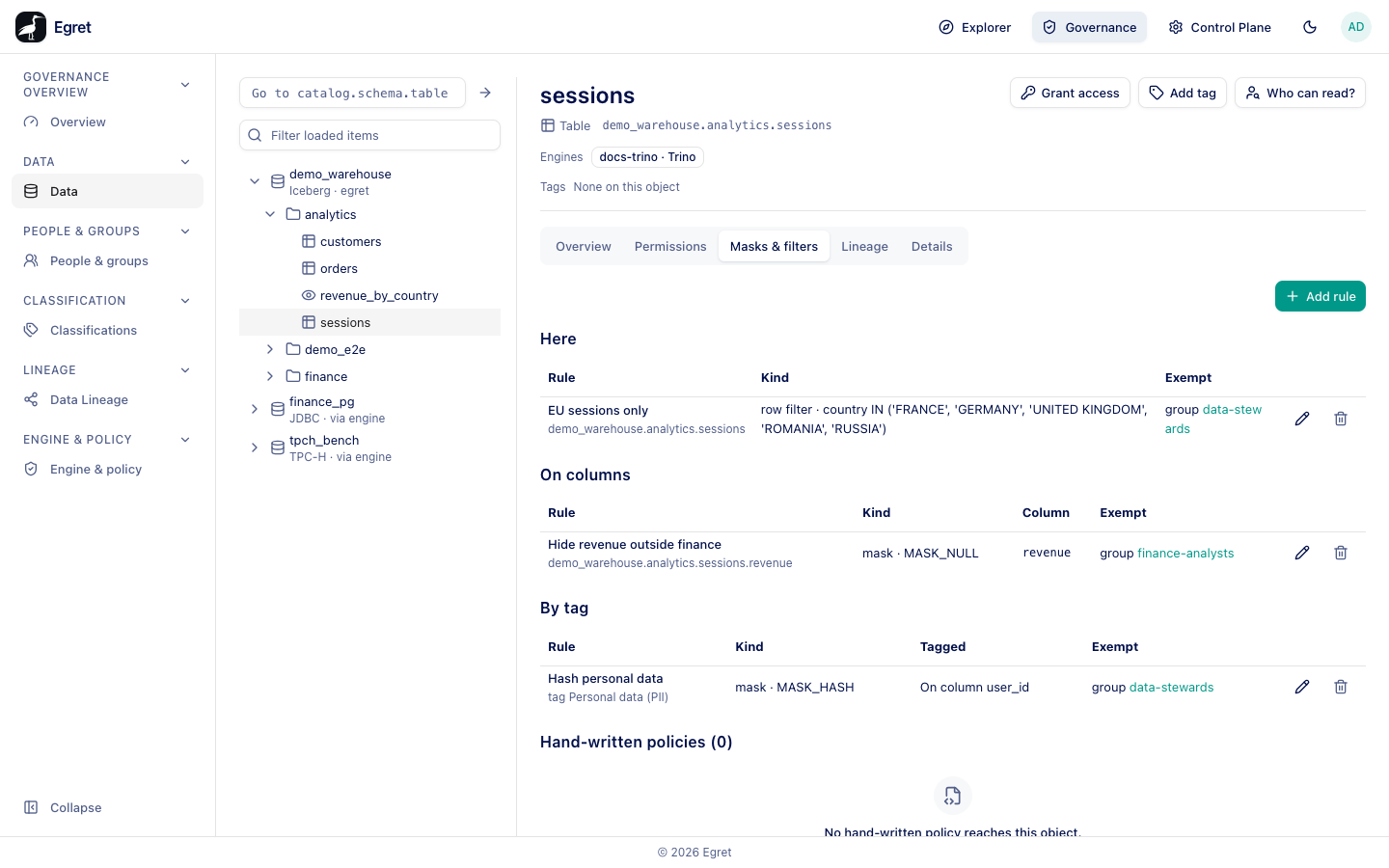
Reading rules needs policy:read. Creating, editing and deleting them needs policy:update.
Read the Masks & filters tab
The tab lists the rules that select the object you opened, in groups. A group appears only when it has rules.
| Group | Holds |
|---|---|
| Here | Rules whose path names exactly this object. |
| Inherited | Rules on a parent (catalog or schema), with a From column. |
| On columns | Rules on a column of this table, with a Column column. |
| By tag | Rules selected by a classification tag, with a Tagged column, for example On column user_id. |
| Matching a pattern | Rules whose path uses a pattern, with a Pattern column. |
Each row shows the rule Name, the path or tag it selects, its Kind (for example mask · MASK_HASH or row filter · user_id IS NOT NULL) and who is Exempt. A tag rule is listed on every tagged table, not on the catalog or schema pages; those say Tag-based rules are listed on each table's page. An empty tab says No mask or row filter selects this table.
Create a rule
- Open the table and select the Masks & filters tab.
- Press Add rule. The dialog New rule opens with the path preset to this table.
- Type a Name. A name is required: Name the rule.
- Choose the Kind: Filter rows or Mask a column.
- Fill the kind's field: Filter expression for a row filter, Mask type for a mask.
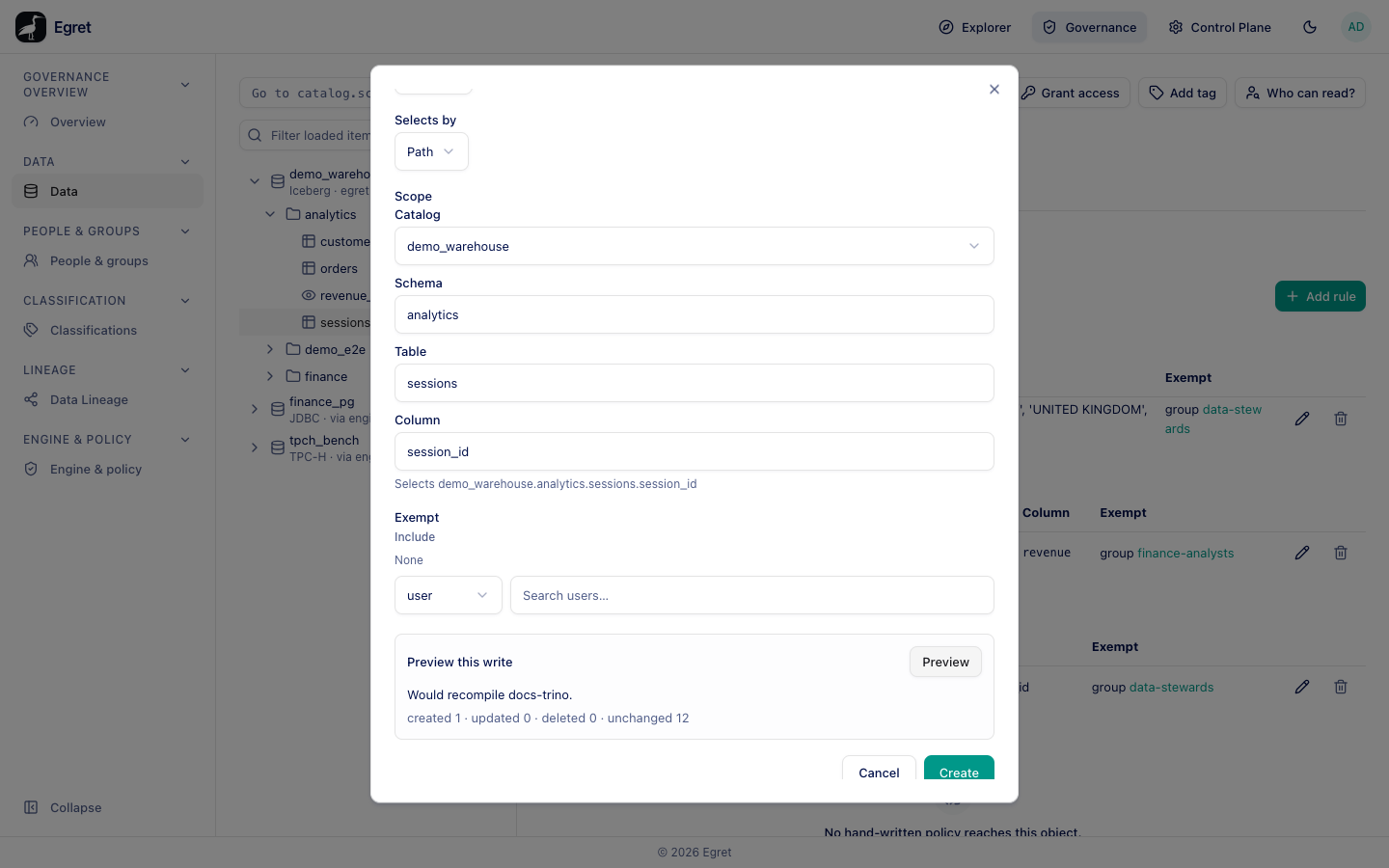
- Choose what the rule Selects by: Path or Tag, and name the target.
- Optionally add Exempt users and groups.
- Press Preview, read the result, then press Create. You see Rule created.
Kind
| Option | What it does |
|---|---|
| Mask a column | Replaces the column's values for every non-exempt reader. |
| Filter rows | Keeps only rows for which the expression is true. |
Mask type
The list is fixed and mirrors Ranger's own vocabulary:
| Mask type | Result |
|---|---|
| Redact | Characters are replaced by a fixed character. |
| Partial mask: show last 4 | Only the last four characters stay visible. |
| Partial mask: show first 4 | Only the first four characters stay visible. |
| Hash | The value is replaced by its hash. |
| Nullify | The value becomes NULL. |
| Unmasked (retain original value) | Explicitly leaves the value as it is. Use it with another rule to carve out an exception. |
| Date: show only year | A date keeps only its year. |
| Custom | You write the expression. A custom mask needs one: A custom mask needs an expression. Example: cast(NULL as {type}). |
Filter expression
A SQL boolean expression over the table's columns, for example region = 'us' or user_id IS NOT NULL. Egret stores it as written and the engine evaluates it, so it must be valid in the engine's dialect.
Selects by
| Option | Fields | Notes |
|---|---|---|
| Path | Scope: catalog (required), schema, table, and column for a mask. | A row filter by path needs catalog, schema and table together, and never a column; the dialog shows no column field and blocks saving until the three are set. A line below the fields reads Selects demo_warehouse.analytics.sessions. |
| Tag | Tag: search tags by name and pick one. | The rule applies to every table or column carrying the tag. The tag is stored by its key, shown as stored as personal-data-pii. Change picks another. A tag rule is catalog-unscoped. |
Exempt
The principals the rule does not apply to. The picker offers user and group only, and no Exclude list, because Ranger's mask and row-filter items cannot express a role or an exclusion. Egret refuses both at compile time.
Preview this write
Like grants, a rule needs a current Preview before Create. For a tag rule the preview text warns: A tag rule is catalog-unscoped, so this can recompile every Trino profile in the installation — see which, here, before committing. A result reads, for example, Would recompile docs-trino. created 1 · updated 0 · deleted 0 · unchanged 12.
Edit and delete
Rows have Edit and Delete buttons. An edit replaces the whole rule, including Exempt: a field left out is cleared. Deleting shows This rule is permanently removed and every profile it reaches recompiles. A rule with a pattern states how far it reaches. Each rule also has a page, /governance/rules/<id>, showing its Kind, what it Selects, and who is Exempt.
When two rules collide
Two mask or row-filter rules that select the same column or table at the same priority make the engine's decision ambiguous. Egret refuses to write a rule that creates such a pair as part of the same write, and reports older pairs on the profile's Overlaps tab. See Policies and overlaps.
Verify a rule
Masks and filters are enforced by the engine, and Who can read? does not report them for Trino. To confirm a rule, query the table as a non-exempt user in SQL Lab, or compare the Policies tab of the engine, where each rule appears as a Masking, Masking (by tag) or Row filter policy compiled by egret.
On the demo stack the sessions table has three rules: the row filter EU sessions only (country IN ('FRANCE', 'GERMANY', 'UNITED KINGDOM', 'ROMANIA', 'RUSSIA'), exempt group data-stewards), the mask Hide revenue outside finance (Nullify on revenue, exempt group finance-analysts) and the tag rule Hash personal data (Hash on every column tagged Personal data (PII), exempt group data-stewards). Queried through docs-trino as member-sso, who is in none of the exempt groups:
SELECT country, count(*) FROM demo_warehouse.analytics.sessions GROUP BY 1;
-- 5 rows: GERMANY 554, FRANCE 375, RUSSIA 484, UNITED KINGDOM 655, ROMANIA 655 (of 15 000 sessions)

SELECT session_id, user_id, revenue FROM demo_warehouse.analytics.sessions LIMIT 1;
-- 52486 | B25935C0F9C4BB9ABCFA13E4C15E56C16564B1390408CB5E24AC68140387D72C | NULL
The local platform admin admin@egret.local got the same masked values: platform admins have all access, but masks and row filters apply to everyone a rule does not exempt.
Limits and known issues
- On a Trino profile without a tag service, tag rules compile to nothing. Egret refuses to bind such a profile to an engine.
- A mask on a column whose type the mask cannot apply to can return an error from the engine rather than a masked value.