Flow control tasks
Flow control tasks decide which other tasks run, in what order, how often and when to wait. Each one holds a list of child tasks. This page shows every flowable task the engine runs, with YAML you can paste into the flow editor and run. All examples use the namespace docs.demo; change it to a namespace you own.
| Task | Use it to |
|---|---|
Sequential | Group tasks that run one after another. |
Parallel | Run tasks at the same time. |
If | Branch on a condition. |
Switch | Branch on a value. |
Dag | Order tasks by their dependencies. |
Loop | Run a group of tasks once for each value. |
LoopUntil | Repeat a group of tasks until a condition is true. |
Subflow | Start another flow and optionally wait for it. |
AllowFailure | Let a block fail without stopping the flow. |
Pause | Wait for a person or a timer. |
WorkingDirectory | Share one working directory between script tasks. |
Task types are written with their full class name, io.kestra.plugin.core.flow.<Task>. ForEach is not a task in Kestra 2.0 and egret refuses it; use Loop.
Sequential
Tasks in a flow already run in order. Sequential groups some of them so a parent can treat them as one step, for example inside a Parallel branch or an If.
- id: wrap_up
  type: io.kestra.plugin.core.flow.Sequential
  tasks:
    - id: step_one
      type: io.kestra.plugin.core.log.Log
      message: Step one
    - id: step_two
      type: io.kestra.plugin.core.log.Log
      message: Step two
It takes tasks and an optional errors list.
Parallel
All child tasks start together. concurrent caps how many run at once; 0, the default, means no cap.
- id: notify
  type: io.kestra.plugin.core.flow.Parallel
  concurrent: 2
  tasks:
    - id: notify_sales
      type: io.kestra.plugin.core.log.Log
      message: Sales notified
    - id: notify_finance
      type: io.kestra.plugin.core.log.Log
      message: Finance notified
If
If renders condition and picks then or else. The strings false, 0, -0, an empty string and null count as false; everything else is true.
- id: big_order
  type: io.kestra.plugin.core.flow.If
  condition: "{{ inputs.amount > 1000 }}"
  then:
    - id: flag_review
      type: io.kestra.plugin.core.log.Log
      message: "Order of {{ inputs.amount }} needs review"
  else:
    - id: auto_approve
      type: io.kestra.plugin.core.log.Log
      message: Order auto-approved
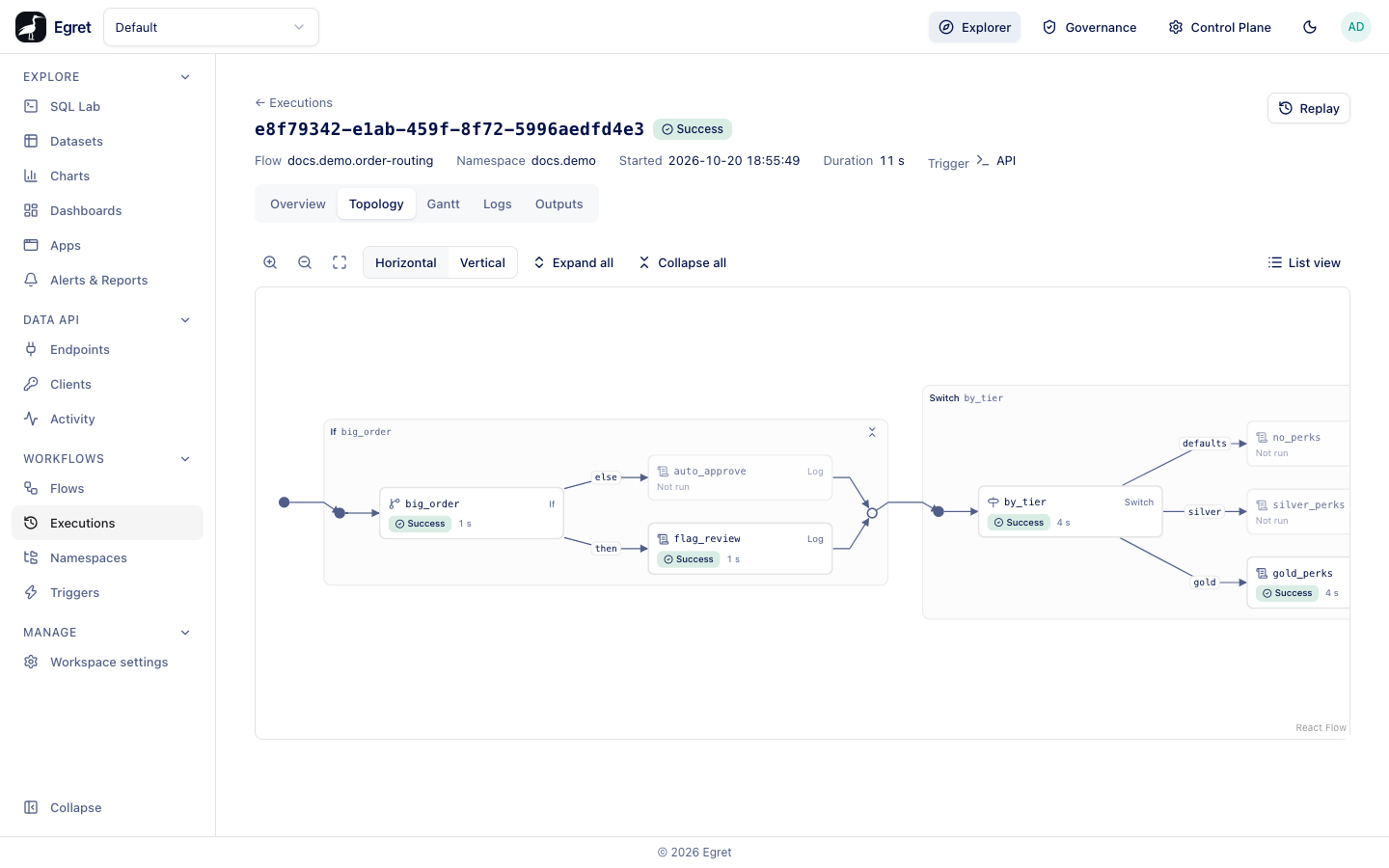
If has the output evaluationResult. On a finished run, the branch that did not run shows as Not run in the topology.
Switch
Switch renders value and runs the cases entry with that key. When no key matches, defaults runs.
- id: by_tier
  type: io.kestra.plugin.core.flow.Switch
  value: "{{ inputs.tier }}"
  cases:
    gold:
      - id: gold_perks
        type: io.kestra.plugin.core.log.Log
        message: Gold perks applied
    silver:
      - id: silver_perks
        type: io.kestra.plugin.core.log.Log
        message: Silver perks applied
  defaults:
    - id: no_perks
      type: io.kestra.plugin.core.log.Log
      message: No perks
The If and Switch above, with the Parallel and Sequential examples, make the flow order-routing. Its execution looks like this:
Dag
Dag lists tasks with dependsOn, and the engine works out the order and which can run together. Each entry wraps a task in task:. A cycle or a dependency on a task that is not in the block is an error when you save (dag_cycle, dag_dependency_not_found).
- id: pipeline
  type: io.kestra.plugin.core.flow.Dag
  tasks:
    - task:
        id: extract
        type: io.kestra.plugin.core.log.Log
        message: extract
    - task:
        id: transform
        type: io.kestra.plugin.core.log.Log
        message: transform
      dependsOn:
        - extract
    - task:
        id: load
        type: io.kestra.plugin.core.log.Log
        message: load
      dependsOn:
        - transform
Loop
Loop is Kestra 2.0's ForEach. It renders values and runs the child tasks once for each item. Inside the loop, {{ item.value }} is the current item, {{ item.index }} its position, and {{ item.key }} the key when values is a map.
- id: per_region
  type: io.kestra.plugin.core.flow.Loop
  values: ["emea", "apac", "amer"]
  concurrencyLimit: 2
  tasks:
    - id: announce
      type: io.kestra.plugin.core.log.Log
      message: "Processing {{ item.value }} (index {{ item.index }})"
| Property | What it does | Default |
|---|---|---|
values | A YAML list, a map, a JSON array in a string, or an expression such as "{{ inputs.regions }}". An internal-storage URI runs one iteration per line of the file. | required |
concurrencyLimit | 1 runs iterations one at a time, in order. N runs up to N together. 0 runs them all together. | 1 |
transmitFailed | Whether a failed iteration fails the Loop. | true |
tasks | The body, run once per item. | required |
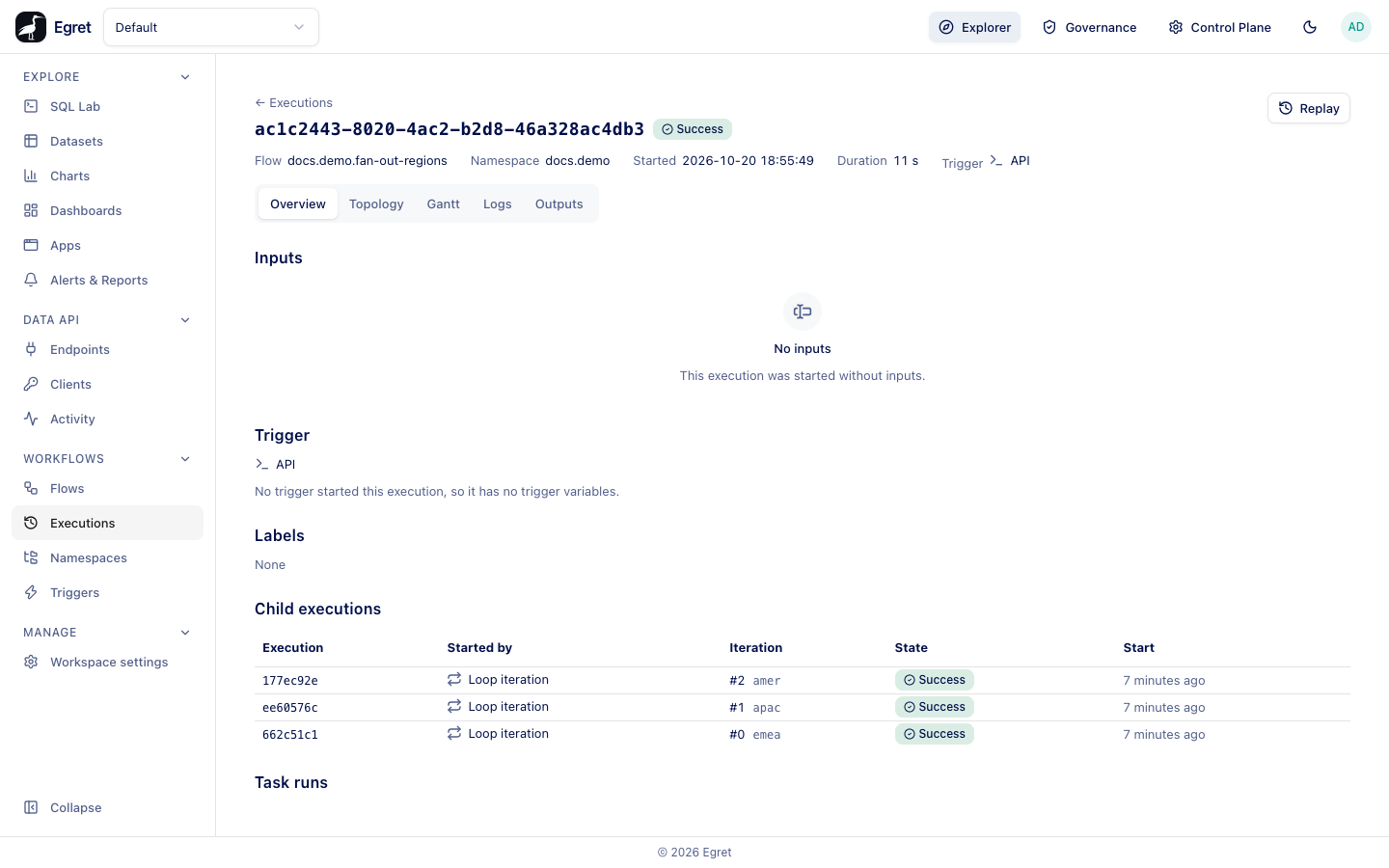
Each iteration is its own execution. The parent execution shows only the Loop task. Each item starts a child execution with the flow's tasks inside the loop, and the parent's Overview tab lists them under Child executions with the iteration number and value. The tasks inside the body have no task runs in the parent, so their outputs are not reachable from tasks after the loop.
LoopUntil
LoopUntil runs its tasks, then checks condition. It repeats until the condition is true or a limit in checkFrequency is reached. The loop's own outputs are under outputs.<id>, with iterationCount.
- id: wait_for_it
  type: io.kestra.plugin.core.flow.LoopUntil
  condition: "{{ outputs.wait_for_it.iterationCount >= 3 }}"
  checkFrequency:
    interval: PT1S
    maxIterations: 5
  tasks:
    - id: tick
      type: io.kestra.plugin.core.log.Log
      message: "Check number {{ outputs.wait_for_it.iterationCount }}"
This run logged Check number 1, 2 and 3 and then succeeded. checkFrequency takes interval, maxIterations and maxDuration; they must be literal values, not expressions. With failOnMaxReached: true the task fails when a limit is reached. While the loop waits for the next check the execution shows Paused, and Resume is disabled with Waiting on a loop condition, not a Pause task.
Subflow
Subflow starts another flow in the same workspace as a new execution. With wait: true (the default) the parent waits for it.
- id: add
  type: io.kestra.plugin.core.flow.Subflow
  namespace: docs.demo
  flowId: add-numbers
  wait: true
  inputs:
    a: 20
    b: 22
The subflow's id and namespace must exist in the workspace. A subflow that calls itself is refused (self_subflow). The task's outputs are executionId, state and outputs. Today outputs is always empty, because flow-level outputs: are not computed. With transmitFailed: true (default) a failed subflow fails the parent. A Subflow appears in the topology as a node you can expand.
The called flow:
id: add-numbers
namespace: docs.demo
inputs:
  - id: a
    type: INT
  - id: b
    type: INT
tasks:
  - id: sum
    type: io.kestra.plugin.core.output.OutputValues
    values:
      total: "{{ inputs.a + inputs.b }}"
AllowFailure
AllowFailure runs its tasks in order. If one fails, the rest of the block is skipped, the block ends in a warning and the flow continues with the next task.
- id: optional_block
  type: io.kestra.plugin.core.flow.AllowFailure
  tasks:
    - id: may_fail
      type: io.kestra.plugin.core.execution.Fail
      errorMessage: expected
- id: after
  type: io.kestra.plugin.core.log.Log
  message: still runs
The run ends in the Warning state, with may_fail failed and after successful. For one task use allowFailure: true on the task instead; see Retries, errors and timeouts.
Pause
Pause stops the execution in the Paused state until a person resumes it or a timer ends.
- id: gate
  type: io.kestra.plugin.core.flow.Pause
  pauseDuration: PT5S
Without pauseDuration it waits until someone resumes it: open the execution and press Resume. With pauseDuration it resumes on its own after that time; in testing a 5-second pause went PAUSED, RESTARTED, RUNNING, SUCCESS without help.
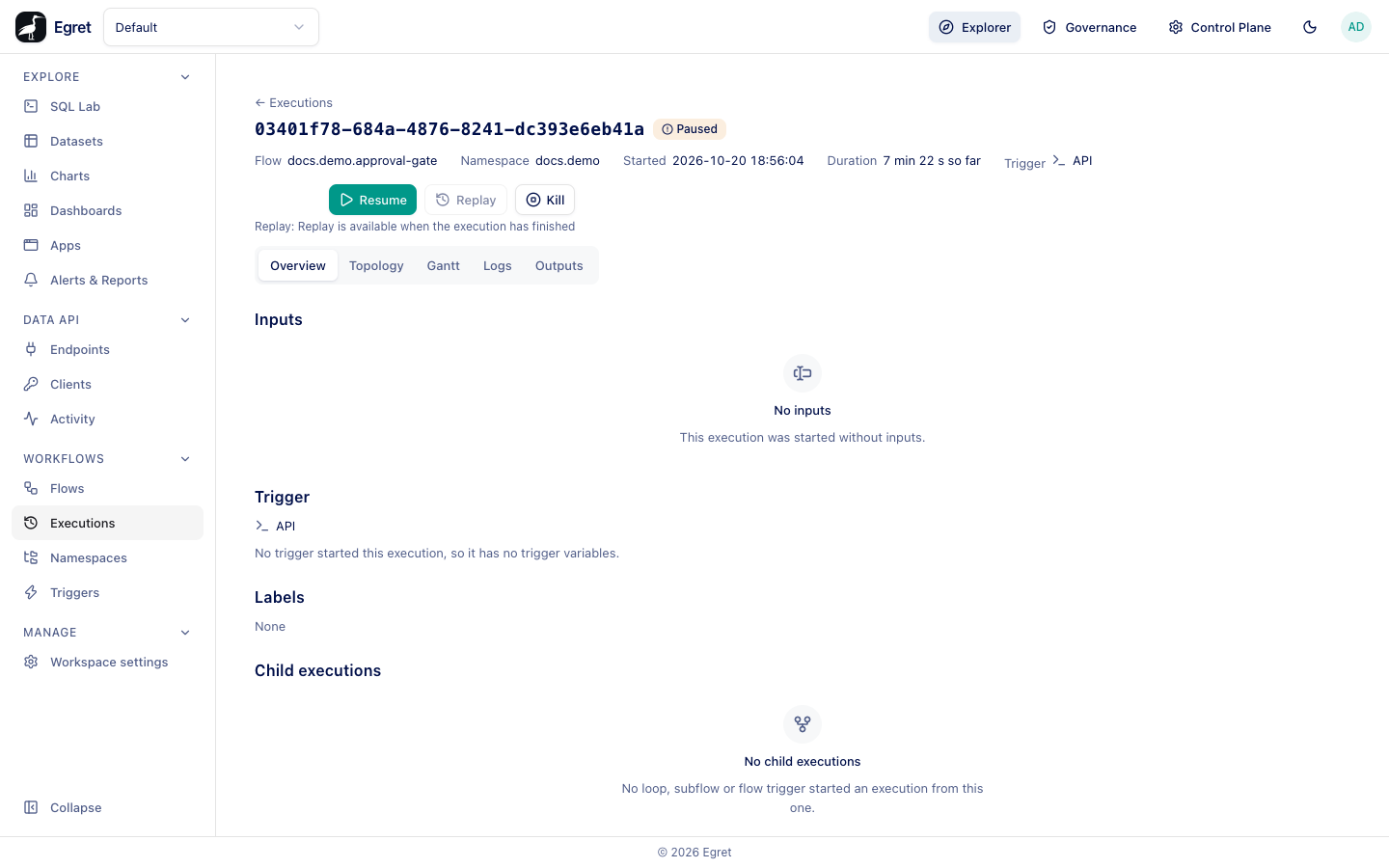
A pause can only be released through the page or the API (POST /executions/{id}/resume). Pause accepts pauseDuration only: tasks, errors, behavior and onPause are refused when you save, and onResume is accepted and ignored. Killing a paused execution ends it KILLED at once.
WorkingDirectory
WorkingDirectory runs child script tasks one after another on the same filesystem, so files written by one task are visible to the next. It supports inputFiles, outputFiles, namespaceFiles and cache. Its children must be script tasks, and flowable tasks inside it are not supported.
- id: build
  type: io.kestra.plugin.core.flow.WorkingDirectory
  tasks:
    - id: write
      type: io.kestra.plugin.scripts.shell.Commands
      commands:
        - echo "hello" > note.txt
    - id: read
      type: io.kestra.plugin.scripts.shell.Commands
      commands:
        - cat note.txt
Script tasks need a container runner (workflow.container_runner = docker) and the Workflow containers workspace feature. The Docker demo stack has neither, even though it runs on Docker, so this example is refused there and is documented from the source. WorkingDirectory runs with the Docker runner only; Kubernetes support is planned. See Runtime and operations.
Limits and known issues
- Flow-level
finally:andafterExecution:never run. On flowable tasks onlyAllowFailurerunsfinally. See Retries, errors and timeouts. - A
Loopdoes not expose its ownoutputs:yet. Pausecannot hold child tasks,errorsoronPause.LoopUntilbounds must be literals.