OpenAPI export
Every consumer of an endpoint needs to know its URL, its parameters and the shape of its answer. Egret generates an OpenAPI 3.0.3 document from the published versions of your endpoints, so a client generator, an API explorer or a coworker reading the contract all see the same thing the endpoint serves.
The document is generated per service account. It lists exactly the endpoints that account may invoke. An endpoint the account has no grant on is absent entirely, including its path, parameters and column names. An empty paths object therefore means the account has been granted nothing, not that the workspace is empty.
Download from the UI
Two places offer Download OpenAPI:
- Endpoints list, top right: the document for every live endpoint the chosen account may invoke.
- An endpoint's Response tab: the contract of that one endpoint.
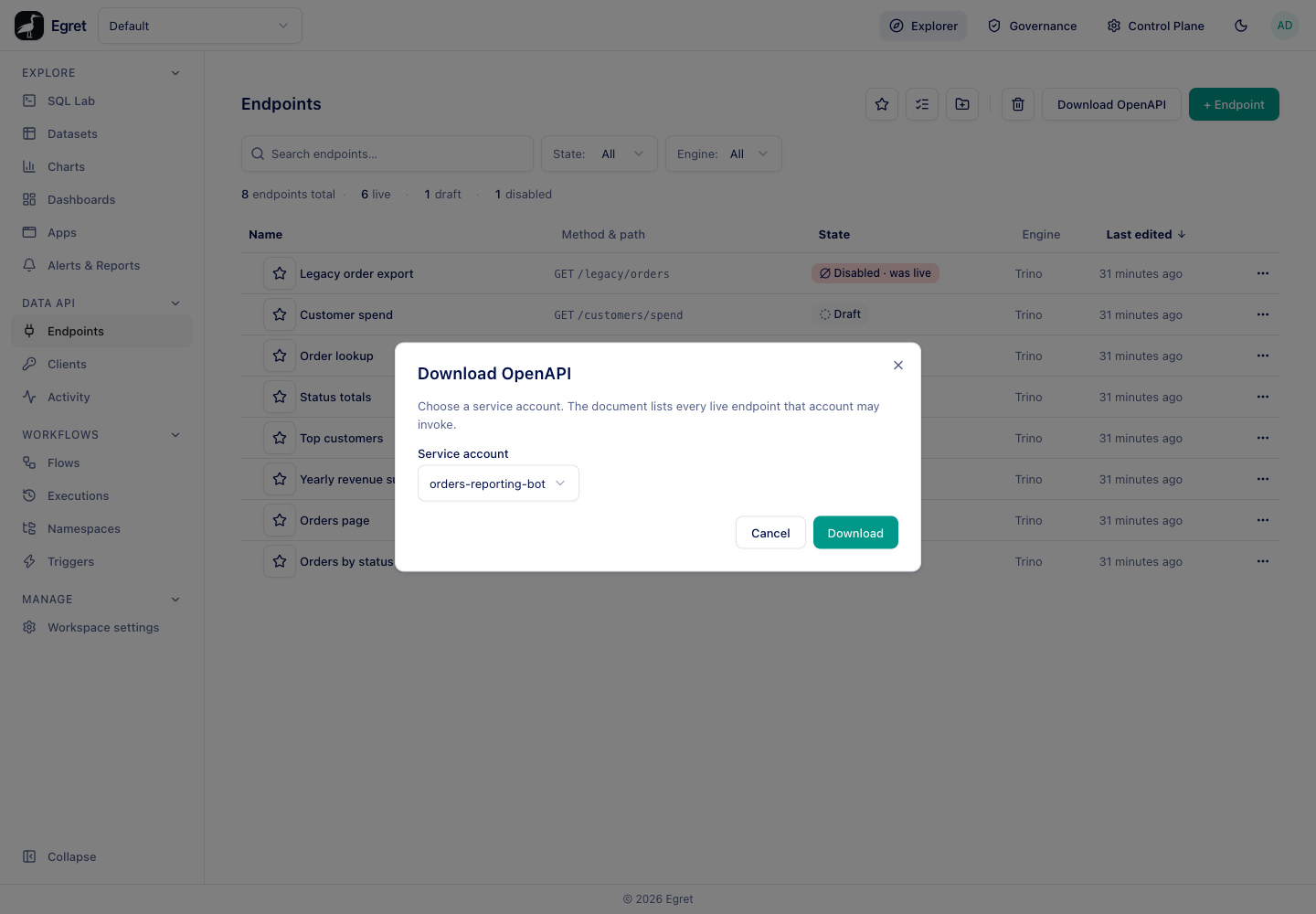
- Press Download OpenAPI.
- Under Service account, choose the account the document is for. The dialog says Choose a service account. The document lists every live endpoint that account may invoke. (From an endpoint: Choose the service account this document describes invoke rights for.)
- Press Download. The browser saves
openapi.json, oropenapi-<endpoint id>.jsonfor a single endpoint.
If the workspace has no service accounts the dialog says No service accounts yet — create one under Clients. Downloading needs the data_api_endpoint:manage permission; without it the dialog reports You need the data_api_endpoint:manage permission to download this document.
Fetch it as a consumer
A consumer can read its own contract with its token. The path is the workspace base URL with nothing after it:
curl -s "$BASE/data-api/v1/default" -H "Authorization: Bearer $TOKEN"
The account is read from the token, so the document is always the caller's own, never another account's. It is generated for each request, reflects grants, publishes and endpoint states at that instant, and is not cacheable (Cache-Control: no-store). Building it is the most expensive request on the surface, so it has its own rate limit per service account, shared by all its clients: 429 rate_limited with Retry-After.
The management API offers the same for administrators: GET /api/ws/{workspace}/data-api/openapi?service_account_id=…, with an optional endpoint_id.
What the document contains
From the walk-through workspace on the demo stack (port 8080), for the service account orders-reporting-bot. partner-sandbox, whose only grant is on the disabled Legacy order export, gets an empty paths object:
{
  "openapi": "3.0.3",
  "info": { "title": "Data API", "version": "1.0.0" },
  "servers": [{ "url": "http://egret.localtest.me:8080/data-api/v1/default" }],
  "security": [{ "egret_oauth2": [] }],
  "components": {
    "securitySchemes": {
      "egret_oauth2": {
        "type": "oauth2",
        "flows": { "clientCredentials": { "tokenUrl": "http://egret.localtest.me:8080/oauth/token", "scopes": {} } }
      }
    }
  },
  "paths": { "/customers/top": {}, "/orders/by-status": {}, "/orders/lookup": {}, "/orders/page": {}, "/orders/status-totals": {}, "/reports/yearly": {} }
}
| Part | Content |
|---|---|
servers[0].url | The workspace's base URL. Join it with a key from paths to get a callable URL. |
components.securitySchemes | OAuth2 client_credentials, with the token URL. The client ID and secret are the ones issued with the service account. |
components.schemas | The shared error body: ServingErrorBody, ServingErrorDetail (with every error.code), ServingColumn, StatementMeta. |
paths | One path per granted, live endpoint. |
An operation
Each operation carries the endpoint's published definition:
| Field | Comes from |
|---|---|
operationId | dataApi_ plus the endpoint id. |
summary, description | The endpoint's Name and Description. |
parameters | The declared parameters: name, in: query, whether required, the description, and a schema built from the type and constraints (enum list, minimum and maximum, string length and pattern, date or date-time format). Each description ends with a note that repeating a key supplies a list and that + decodes to a space. |
An X-Egret-Version header parameter | Lets a caller pin a version. |
x-egret-version | The version the document describes, which is the live version. |
responses | 200 with the schema of the success envelope, built from the frozen columns, plus every error status. |
For a column, the schema is a JSON type and nullable: true, and x-egret-engine-type records the engine's own type, for example "x-egret-engine-type": "varchar(1)". A column that may be absent (from a branch that only some parameters reach) is left out of required. For an endpoint with several statements, data is an object whose properties are the statement names.
For example, the year parameter of the Yearly revenue summary endpoint:
{
  "name": "year", "in": "query", "required": true,
  "description": "Calendar year (1992-1998)",
  "schema": { "type": "number", "minimum": 1992, "maximum": 1998 }
}
(The real description also carries the note about repeated keys.)
The error statuses documented on every operation are 400, 401, 403, 404, 409, 413, 429, 500, 502, 503 and 504, each with the codes that produce it, as in the error reference.
Use it
- Import it into an API explorer or a client generator. Authentication is the OAuth2 client-credentials flow described in the document itself.
- Commit it next to a consumer as a contract. Because it comes from the published version, it changes only when you publish, and a version number in
x-egret-versionshows which. - Check a grant: fetching the document with a token shows exactly what that account can call.
Limits and known issues
- The document is generated from the published version. Draft changes do not appear.
- It is generated on demand, so a very large workspace can hit the generation limit; Egret answers
500 internalrather than an incomplete document. - Two columns that collapse onto one key under Naming make an endpoint refuse to document (
503 output_naming_collision); republish after fixing it.